


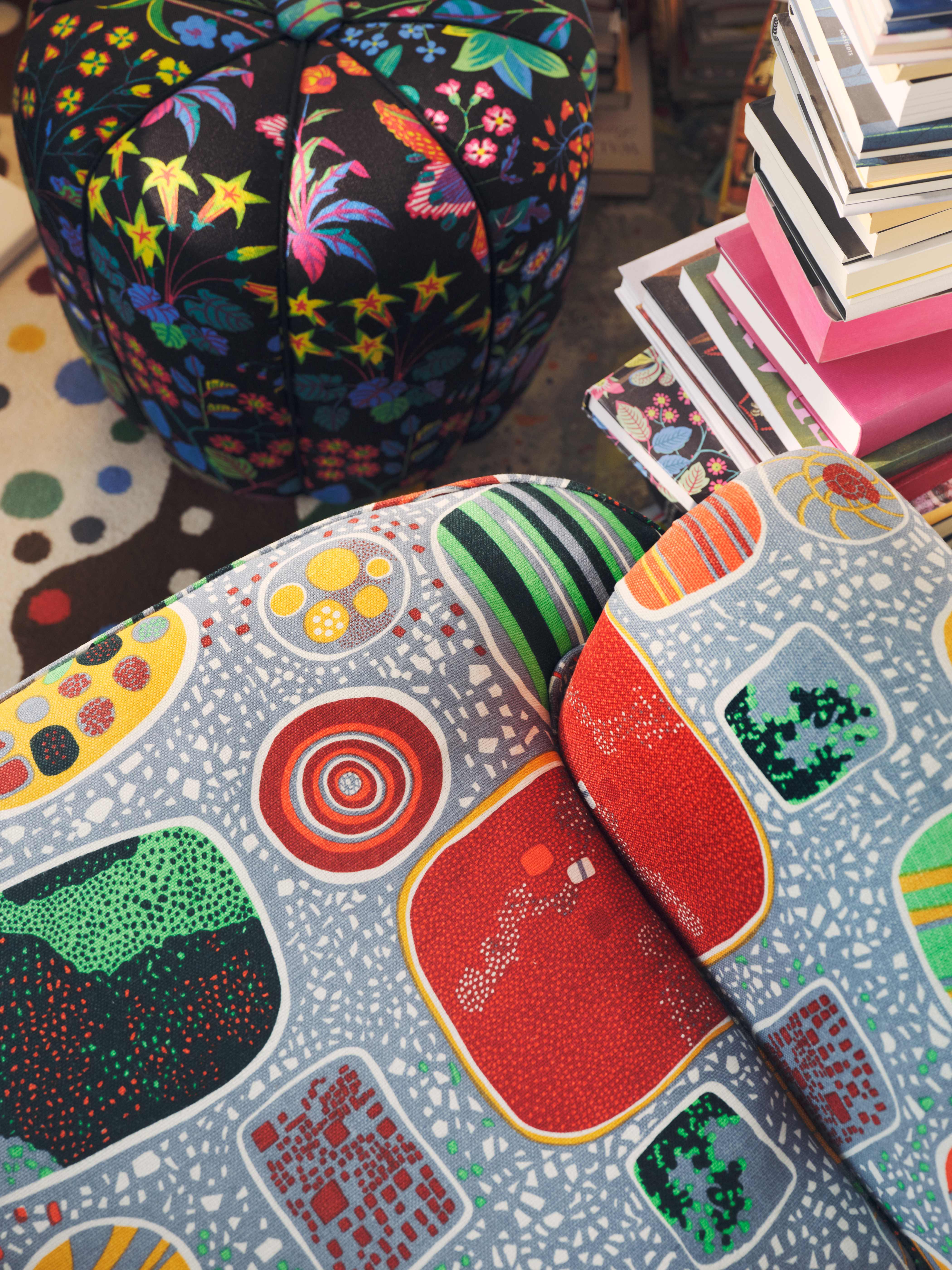


Stockholm cabinet

In connection with the exhibition “Standing Tall”, a conversation on Josef Frank’s cabinets was held at the Svenskt Tenn store on Strandvägen 5 in Stockholm. Moderated by journalist Gunnar Bolin, the talk brought together Eva Seeman, Senior Specialist in Modern and Contemporary Craft and Design at the auction house Bukowskis in Stockholm, as well as Thommy Bindefeld, Senior Advisor, and Johanna Asshoff, Production and Quality Manager, from Svenskt Tenn.
Throughout the evening, the conversation moved between several perspectives on Josef Frank’s cabinets – from form and construction to materials, craftsmanship and auction value.
Eva Seeman“Svenskt Tenn and Josef Frank are a phenomenon continually rediscovered by new generations.”
Already in Josef Frank’s early interiors, a distinct formal language emerges, setting his work apart from contemporary furniture design. In one of his first interiors, designed in 1910 for his sister Hedwig and brother-in-law Karl Tedesko, several of the features that would later come to define his furniture are already present: slender lines, characteristic legs and elegant proportions.
As Thommy Bindefeld noted, the high legs were part of Frank’s vision of how a room should be experienced. A central idea was that a room should be clearly perceived upon entering. For this reason, Frank designed furniture that allowed the meeting between floor and wall to remain visible. In the same way, many of his chairs are open in their construction, so they do not obstruct the overall perception of the space.
Although the cabinets were created during different periods of Frank’s life, there is a clear continuity in their formal language. The same aesthetic recurs in later pieces – a lightness in proportion and a distinct idea of how the furniture should relate to the room.
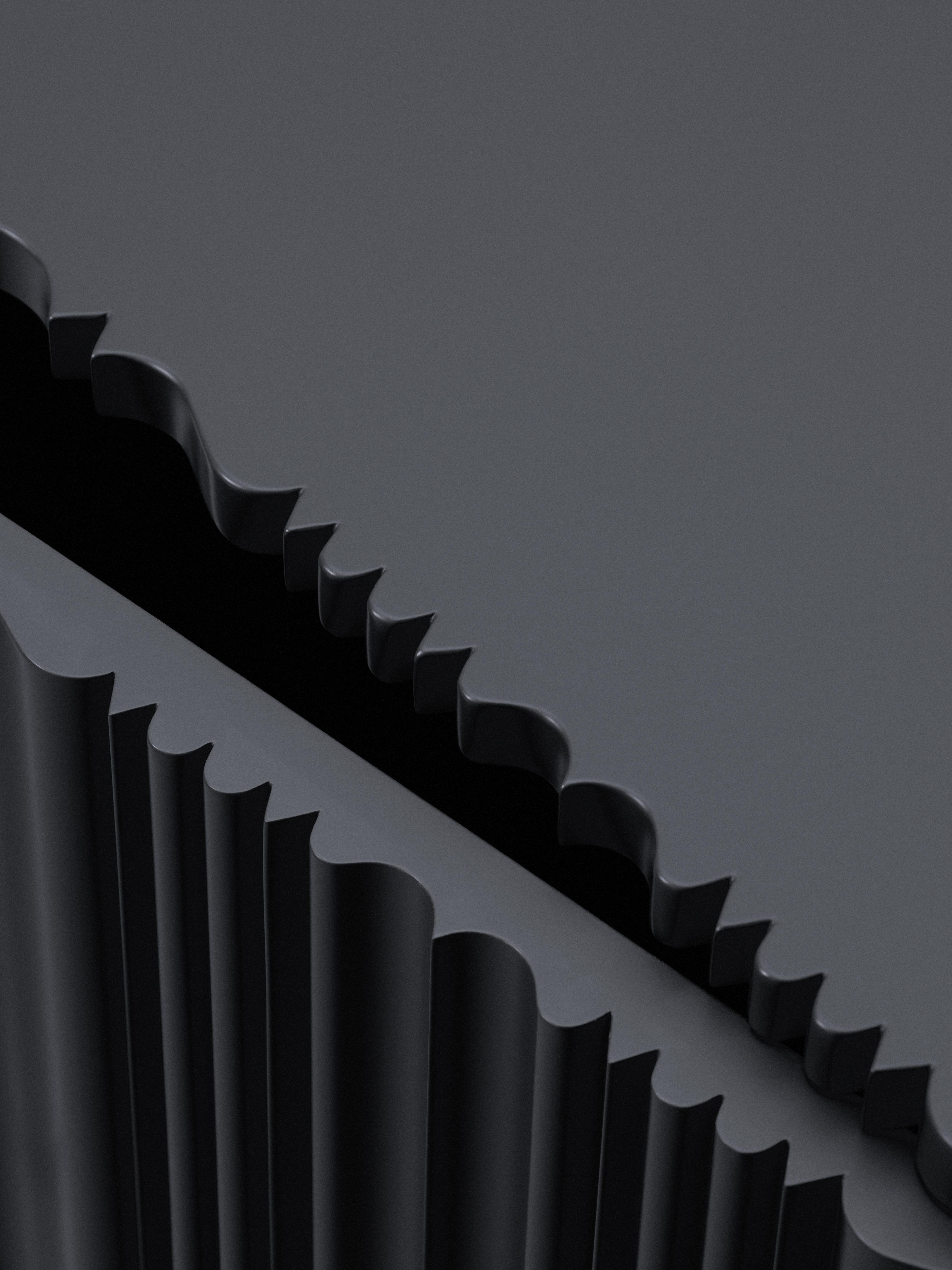
Cabinet 2192 in detail
Behind Josef Frank’s cabinets lies a level of craftsmanship that is often more advanced than it first appears. As Production and Quality Manager at Svenskt Tenn, Johanna Asshoff works closely with the joineries that produce the furniture and follows the process in detail.
Part of the fascination, she explains, lies in what is not always visible at first glance.
“In my role, I get to see how the cabinets are constructed on the inside and behind what the customer does not see. There are incredibly intricate solutions to almost everything.”
The construction of the furniture reflects a high level of craftsmanship. One example is Cabinet 2192, where the doors’ undulating fronts are formed from a series of milled strips.
For all parts to align precisely, each step requires great accuracy. The strips are milled to a specific profile and then assembled so that the wave continues across the entire surface, while each door still requires hand-finishing and adjustment.
Production takes place in small workshops across Sweden, where each piece is made without time pressure. Fine woodworker Anders Mattsson in Valdemarsvik, who is behind many of the cabinets, works with a small team and places great emphasis on precision in every step.
“Each piece Anders Mattsson makes is treated as a masterpiece,” says Johanna Asshoff.
Josef Frank’s cabinets are often defined by a restrained form, where expression instead comes through the materials. In many pieces, the wood itself becomes a decorative element. Thommy Bindefeld describes how Frank often worked with veneer, while in other cases the cabinets were given a more expressive character through textiles, maps or images. His drawings frequently include clear instructions on how the cabinets were to be clad.
The meeting of different materials is also a key part of Frank’s design language. Johanna Asshoff notes how Frank often combined several types of wood within a single piece:
“In Cabinet 2215, Josef Frank combined birch burl, elm and padauk. These are three woods with distinct expressions, yet the combination is very beautiful.”
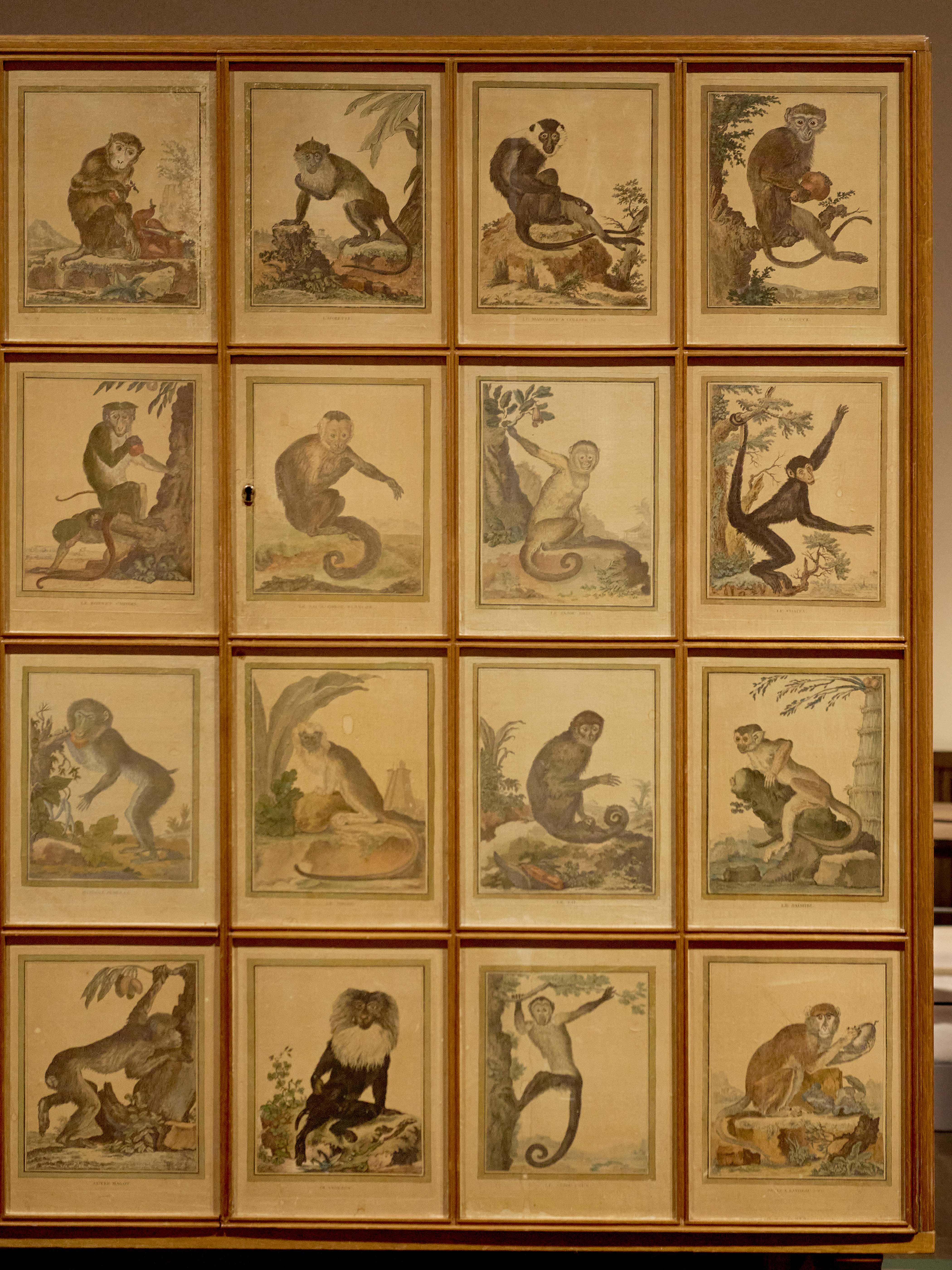
Details from Josef Frank’s “Ape Cabinet”
Josef Frank’s cabinets are sold exclusively at Svenskt Tenn, yet his work continues to attract strong interest at auction. As Eva Seeman of Bukowskis describes it, his furniture continues to find new owners and new contexts.
“Svenskt Tenn and Josef Frank are a phenomenon that is constantly being rediscovered by new generations.”
This demand is reflected both in auction houses’ search statistics, where Josef Frank appears frequently, and in final sale prices. During the conversation, Josef Frank’s “Ape Cabinet” is mentioned – decorated with coloured engravings depicting monkeys. When it was sold at Bukowskis’ Modern Art + Design auction, it achieved a record price of SEK 4,625,000, setting a Swedish auction record for a 20th-century piece of furniture.
The panel also returns several times to how the furniture moves between periods, generations and different types of homes. As Johanna Asshoff puts it:
“What is so special about Frank’s furniture is that it is timeless. It can rest for a period, only to become relevant again and spark renewed interest.”
Thommy Bindefeld adds in closing:
“Josef Frank’s cabinets are not only functional – they also serve as a piece of jewellery in the home.”

